





The Resilient Communities, Schools and Families project is a multi-year project intended to empower schools in disadvantaged and/or rural communities to strengthen community partnerships, promote trauma-sensitive practice and enhance coordination of wrap-around prevention/intervention services for children and families. To help community members learn more about the partners involved in the project, get a better understanding of the core concepts addressed in this work and see a preview of the project, our core team has prepared this web preview and a more extensive downloadable report. These communications efforts are intended to be part of phase one for the project, with additional storytelling efforts planned as the work with schools progresses. Ultimately, we hope the Resilient Communities, Schools and Families project helps to create a powerful example of what is possible in Hawaiʻi in terms of healing individual and community trauma.
FIND OUT MORE

Trauma-Sensitive Education Overview
The Challenge
The Resilient Communities, Schools and Families project addresses a dire need to better support students’ holistic wellness and mental health needs. For example, Hawaiʻi has one of the highest youth suicide rates in the nation. In its 2017 report, the CDC Youth Risk Behavior Survey reported that 1 of 8 middle school students had attempted suicide. Furthermore, the Adverse Childhood Experience Study found that survivors of childhood trauma are up to 5,000% more likely to attempt suicide. Similarly, the ACLU released a 2019 report finding Hawai‘i has disproportionate referral and suspension rates, especially of Hawaiian/Pacific Islander students who are suspended – 3x times the national average. Given these staggering statistics, it is therefore no surprise that less than 50% of public-school students are meeting academic standards.
The Need
Hawaiʻi also has a unique context in that addressing broader cultural, historical and intergenerational trauma is especially important. For Native Hawaiian youth, this kind of trauma can be felt across makua and kūpuna, recognizing years of impact from colonization and the loss of sovereignty. This real trauma includes but is not limited to the loss of land, language and cultural identity.
Intervention is crucial to mitigating the detrimental effects of childhood trauma. Implementing trauma-informed, or trauma-sensitive, practices in schools can have a significant impact, including improvements in behavior, fewer suspensions and expulsions and improvements in academic achievement.1 Osher, David. “Trauma and Learning Policy Initiative (TLPI): Trauma-sensitive schools descriptive study.” (2018). With quality trauma-informed training for educators and school staff, schools can better support students to feel engaged and connected with teachers and peers. Trauma-sensitive training gives educators the tools to be responsive to the social, emotional and behavioral needs of their students.
Closely related to the concept of trauma-sensitive schools is social-emotional learning (SEL), or social and emotional learning. SEL is a whole child approach to education that is not intended to be limited to only supporting students experiencing trauma, but many of the same principles resonate.
SEL is the process through which all young people and adults acquire and apply the knowledge, skills and attitudes to develop healthy identities, manage emotions and achieve personal and collective goals, feel and show empathy for others, establish and maintain supportive relationships and make responsible and caring decisions. SEL advances educational equity and excellence through authentic school-family-community partnerships to establish learning environments and experiences that feature trusting and collaborative relationships, rigorous and meaningful curriculum and instruction and ongoing evaluation.
2 https://casel.org/what-is-sel/
A Powerful Model
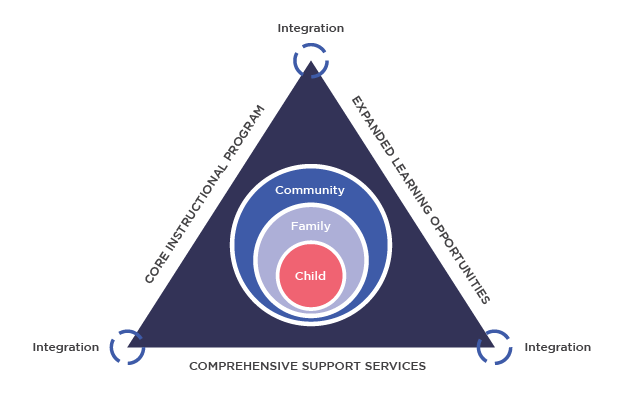
With origins dating back to the late 1800s in Chicago, the Community Schools Model centers around six pillars of practice and four core implementation mechanisms:https://www.nea.org/student-success/smart-just-policies/community-schools
Pillars of practice
- Strong and proven culturally relevant curriculum
- High-quality teaching and learning
- Inclusive leadership
- Positive behavior practices (including restorative justice)
- Family and community partnerships
- Coordinated and integrated wraparound supports (community support services)
Implementation mechanisms
- Community School coordinator
- Needs and assets assessment
- School stakeholder problem solving teams
- Community School stakeholder/partner committee
About 100 school districts have taken on the community schools strategy at scale. One such district is Union Public Schools in Oklahoma, which considers itself a district that has adopted a Community Schools approach. The district’s eight elementary schools — which all receive federal Title I funding — have a community schools coordinator on staff and two schools have full-service medical clinics on-site. These are available to the community as well. In addition, mental health providers see students throughout all district schools and families have access to districtwide clothing support. The Tulsa City-County Health Department also offers nutrition programs and health and wellness programs for students, as well as demonstrations for parents. The Oklahoma Caring Foundation offers free immunizations for all students.
Additionally, community schools in the district offer a range of early childhood programming and adult education. Based on standardized test scores, an external evaluation that controlled for individual student poverty and the diffusion of the strategy in a school concluded that Union’s community schools have narrowed the achievement gap between low-income students and their more affluent peers.https://www.americanprogress.org/issues/education-k-12/reports/2018/08/22/454977/building-community-schools-systems/
Perhaps bolstered by a strong inherent sense of community values and kuleana, Hawaiʻi has some bright spots in adopting the Community Schools Model. In particular, schools in the tight-knit communities of Hāna and Kohala have been listening to the needs of its students, staff and families, displaying strategies to support the development of all the members of the community.
The Approach
The Resilient Communities, Schools and Families project builds upon the best practices of trauma-sensitive approaches and the Community Schools model to create sustainable conditions for schools to better serve students and families, ensure even the most at-risk youth have access to services necessary to thrive within their school, homes and communities and develop a tailored operational approach that builds capacity for schools to strengthen community partnerships.
Goals
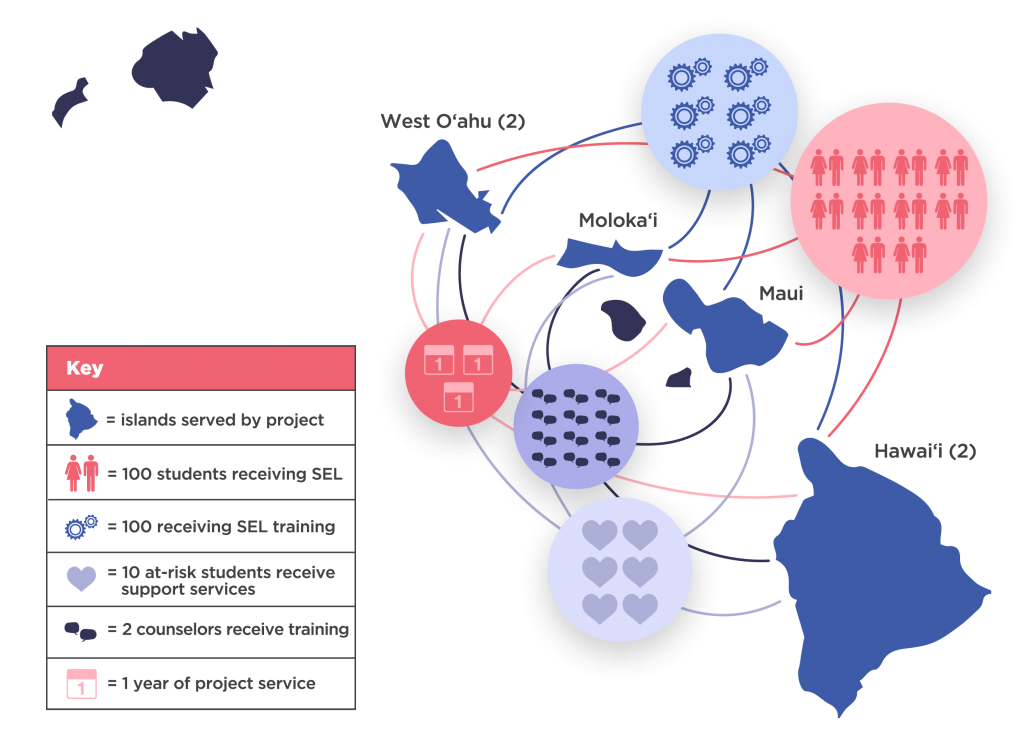
Over three years, the project will serve six rural, remote and otherwise disadvantaged elementary schools on the islands of Molokaʻi, Maui, Hawai‘i (2) and West Oʻahu (2).
-
- At least 1,000 students will receive social and emotional learning (SEL) to gain social and emotional competencies integral to their healthy development (Tier 1)
- 600 teachers, staff and community partners receive training on SEL and trauma sensitive pedagogy
- 60 at-risk students and their families will receive specialized support through Student Resilience Plans and delivery of comprehensive support services (Tier 2)
- 12 school counselors will receive specialized American School Counselor Association training
The project is a collaborative initiative between schools, social service agencies and community organizations to authentically engage them to embrace a mindset shift toward a whole child approach. This is not about narrowly defining success and requiring compliance, but rather an opportunity for schools to honestly reflect on their assets and challenges and ultimately buying in to refining their current practice around wrapping around the whole child. Once schools are selected based on need and meeting a suite of criteria, they will collaborate with the project team to assess the needs of their local communities and produce an asset map of their current programs, activities and prior staff trainings.
Teachers, support staff and community partners will receive professional development from experts in the field in a trauma-sensitive, multi-tiered system of support. Foundational areas of focus include developing competencies with both Trauma Informed Practices (TIPS) and SEL, with additional utilization of Native Hawaiian health practices, peacebuilding and action planning. In addition, school counselors and school-based behavior health coordinators will receive American School Counselor Association training to help students focus on academic, career and social-emotional development. This national model is centered around a set of professional standards and competencies, including mindsets grounded in a belief in the potential of all children, a strong professional foundation in theory and practice, skills to ensure students have access to direct and indirect supports and the knowhow to effectively assess student needs and create plans to address gaps.1
At the core of this project, 10 at-risk Tier 2 students and their families per school will receive specialized support through Student Resilience Plans and delivery of comprehensive support services. Similar to the intent of Individualized Education Plans used for special education services, the Student Resilience Plans are a vehicle for students, educators, parents and support organizations to align around the whole child needs of vulnerable students and develop together the proper interventions for each student. The delivery of Student Resilience Plans will occur through a support team called “Resilience Hui” which are structured to ensure diverse representation of adult supporters who have received training in TIPS and SEL, have an established relationship with the student and are able to provide multiple perspectives on the overall wellbeing of the student: namely, the school counselor, school-based behavioral health and the family facilitator.
Throughout the family engagement process, the Resilience Huis will be intentional about how to guide progress and track outcomes.
Get Involved
The long term goal of the Resilient Communities, Schools and Families project is to build long-term resilience, well-being and community abundance. As such, the project goes beyond communities and children merely surviving difficult situations, but finding their own strength and thriving. We hope to cultivate a spirit of hope and possibility to support the holistic wellbeing of the students of today and tomorrow.
Resilient Communities, Schools and Families project inquiries:
Ivee Cruz
Education Director
Ceeds of Peace
(808) 381-4631
ivee.cruz@ceedsofpeace.org